Mold after water damage
Mold takes hold on wet materials when a leak or burst pipe is not dried quickly, and growth follows from there. EPA's rule is to stop the source and dry water-damaged areas and items within 24 to 48 hours. Call (856) 595-8837: a support manager books a time, and a local specialist from our network gives the estimate on the call. This guide gives the steps in order, from the source to insurance.
- One call, no forms to fill out
- Support manager available 24/7 to confirm your booking time
- A specialist contacts you quickly, sometimes the same day
- Free estimate and inspection, given on the call
- Help with insurance claims
Speak to a support manager · confirm a booking time · get the estimate on the specialist's call
No name, phone or email needed. We count anonymous answers, never contact details, to improve this page.
Call (856) 595-8837. A support manager confirms a booking time, and a local specialist gives the estimate on the call.
Mold Remediation Co. is a referral service. We connect you by phone with independent local mold remediation companies, and their technicians perform the work. We are not a contractor.
What should you do first after a leak or burst pipe to prevent mold?
Stop the water source first, then dry water-damaged areas and items within 24 to 48 hours, the window EPA gives to prevent mold growth. Photograph the damage for insurance, and call a specialist for growth, soaked materials or contaminated water.
Mold grows on wet building materials, so the clock starts when the water stops. EPA's guidance is to fix plumbing leaks and other water problems as soon as possible and to dry wet items and hard surfaces completely.
What are the 5 steps after water damage?
After water damage, take 5 steps: stop the water at the source, dry everything within 24 to 48 hours, document the damage, remove materials that stay wet, and book a specialist to check for hidden mold. Sewage needs a professional.
- Stop the source: shut off the supply line, patch the roof leak or repair the drain. EPA's first rule is to fix the water problem as soon as possible.
- Dry within 24 to 48 hours: EPA's window to prevent mold growth covers water-damaged areas and items. Dry hard surfaces completely.
- Document: photograph every wet and moldy area and keep the date of the leak or burst pipe for the insurance claim.
- Remove what stays wet: EPA's water-damage table lists wet insulation for discard and replacement and treats moldy drywall as a removal item.
- Check for hidden mold: book an inspection when a musty odor, a stain or a soft wall appears after the water is gone.
How fast does mold grow after water damage?
EPA's rule is to dry water-damaged areas and items within 24 to 48 hours to prevent mold growth. Mold takes hold when materials stay wet past that window, so the first 2 days decide whether a leak becomes a mold job.
Dry hard surfaces completely. Materials that cannot dry in that window, such as wet insulation, are listed for discard in EPA's water-damage table. A slow leak, such as a drip under a sink or a seep behind a wall, keeps materials wet for weeks, so it feeds growth without any dramatic event.
Where does mold show up after a burst pipe, roof leak or under-sink drip?
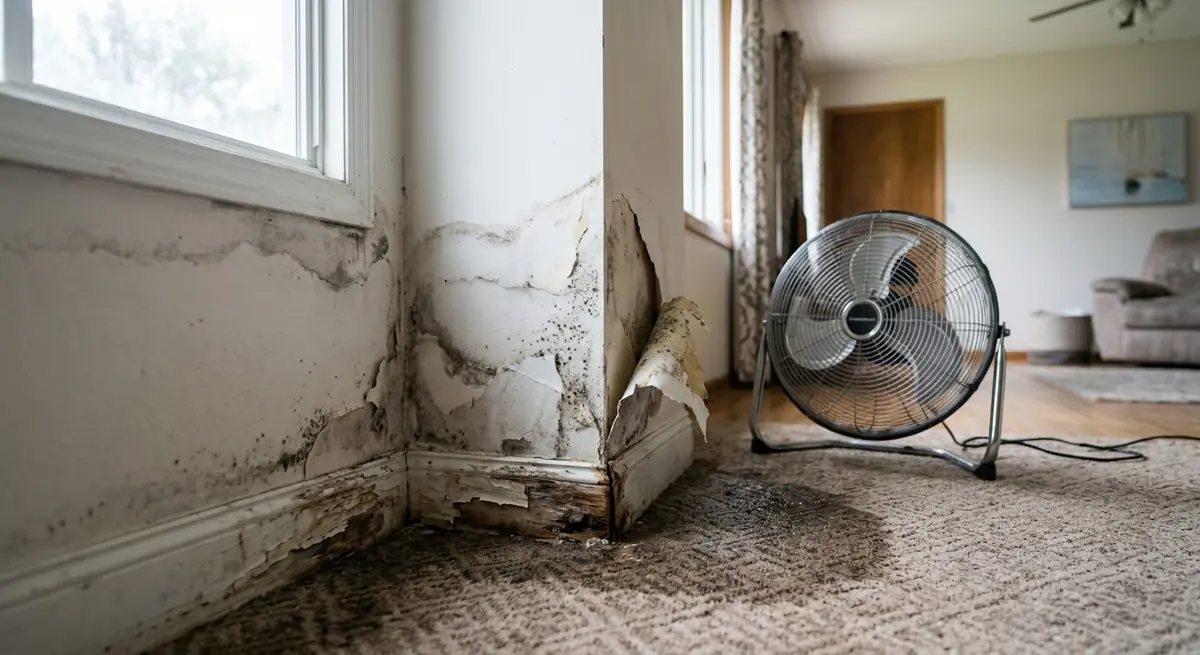
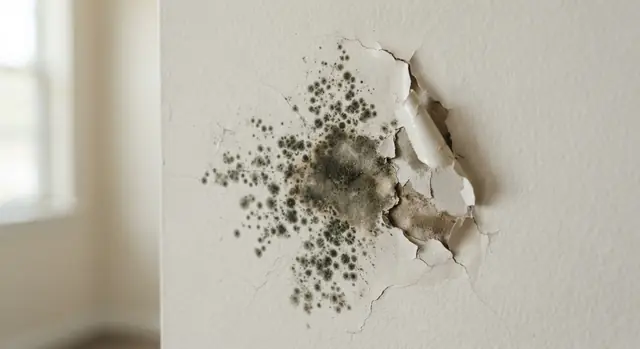
Mold shows up wherever water stays: the wall around a burst pipe, the attic sheathing and ceiling below a roof leak, and the cabinet floor under a dripping sink. EPA lists roof leaks and plumbing leaks as moisture sources behind indoor mold.
Burst pipe or supply line
A burst pipe wets drywall, insulation and flooring around it. Shut off the water, dry the area and keep the dates for the claim.
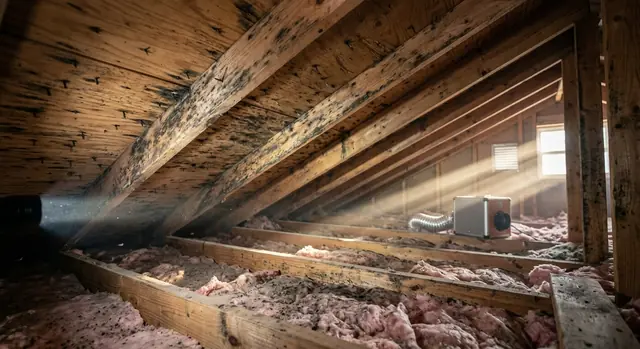
Roof leak
A roof leak wets sheathing, insulation and the ceiling below it. Our guide to mold in the attic covers cleanup and airflow fixes.
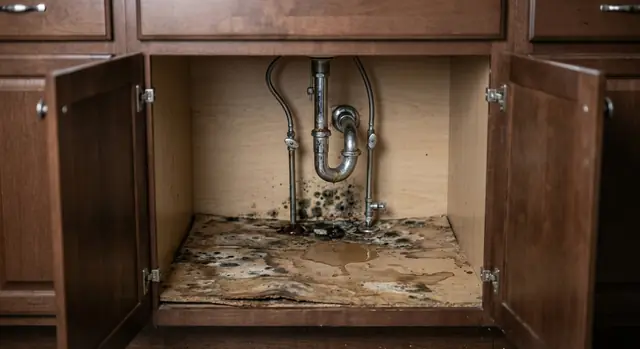
Slow drip or seep
A drip under a sink or behind a wall keeps materials wet for weeks. Musty odor with no visible source calls for an inspection.
Which water-damaged materials must come out?
EPA's water-damage table lists wet fiberglass and cellulose insulation for discard and replacement and treats moldy drywall as a removal item. Hard, non-porous surfaces are scrubbed with detergent and water and dried completely. The quote names each item.
Sewage or contaminated water changes the job: EPA advises hiring a professional for it. Do not run a heating or cooling system that smells musty, per EPA. Our guide to which moldy materials must be removed sorts each material into clean or remove.
Does homeowners insurance cover mold after water damage?
Homeowners insurance usually covers mold only when a sudden covered event, such as a burst pipe, caused it. It usually excludes flood, long-term leaks and humidity, caps mold payouts in some policies, and expects the owner to limit further damage.
Photograph every wet and moldy area before removal starts, and read the policy's mold limit before work begins. Flood is separate: FEMA's flood insurance FAQ names 2 exceptions to the NFIP mold exclusion, an official barred entry to the property, or floodwater that kept the owner from reaching it. Our network helps with insurance claims. Our guide to mold after flooding covers floodwater-soaked homes.
Where can you get water-damaged mold checked?
One call to (856) 595-8837 reaches a support manager, who confirms a booking time. A local specialist from our network then gives the estimate on the call and checks the wet area for mold. City pages list covered ZIP codes.
Flood-prone coastal areas see the most water-damage mold. See mold remediation around Miami or Homestead mold remediation, and read where indoor moisture comes from for the non-flood sources.
Mold after water damage FAQ
Can I dry a water leak myself to prevent mold?
Homeowners dry small leaks themselves by fixing the source and drying hard surfaces and items completely within 24 to 48 hours, per EPA. Sewage, contaminated water, or soaked insulation and drywall that will not dry call for a professional.
Do I need a mold test after a burst pipe?
A mold test is not the first step. EPA calls sampling unnecessary in most cases where mold is visible, and CDC does not recommend mold testing. An inspection with moisture readings shows which materials are still wet.
What if I find mold weeks after the leak was fixed?
Mold weeks after a fixed leak means materials stayed wet or a second moisture source remains. Moisture readings find the wet material. Growth under about 10 square feet is a homeowner job per EPA; larger areas need a specialist.
Does homeowners insurance pay for mold from a burst pipe?
A burst pipe is the usual covered path: policies pay for mold mainly when a sudden covered event caused it. Photograph the damage, keep the leak date and read the policy's mold limit, because some policies cap mold payouts.
Is mold after flooding handled differently?
Floodwater is handled differently because EPA advises a professional for sewage and contaminated water, and flood insurance carries its own mold exclusion. Our guide to mold after flooding covers the floodwater steps in order, from cleanup to claims.
Leak or burst pipe in the last 2 days? Call (856) 595-8837. A support manager books your time, and a local specialist gives the estimate on the call.
Call (856) 595-8837