What Causes Mold in a House
Moisture causes mold in a house, and 7 sources account for most indoor growth: roof leaks, plumbing leaks, gutters and grading, high humidity, condensation, unvented combustion appliances and deferred maintenance. Fix the water first. Mold Remediation Co. is a referral service: call (856) 595-8837, a support manager books a time, and a local specialist gives the free estimate on the call.
- One call, no forms to fill out
- Support manager available 24/7 to confirm your booking time
- Free estimate and inspection, given on the call
- Independent clearance testing available
Support manager first · booking time confirmed · free estimate from the local specialist on the call
No name, phone or email needed. We count anonymous answers, never contact details, to improve this page.
Call (856) 595-8837. A support manager confirms a booking time, and a local specialist gives the estimate on the call.
Mold Remediation Co. is a referral service. We connect you by phone with independent local mold remediation companies, and their technicians perform the work. We are not a contractor.
What causes mold in a house?
Moisture causes mold in a house. EPA names roof leaks, plumbing leaks, gutters and landscaping that direct water inside, unvented combustion appliances and deferred maintenance, and condensation and humidity add more. Controlling the moisture controls the mold.
EPA's guidance on indoor mold rests on one point: mold growth is controlled indoors by controlling moisture. Cleaning a surface does not change that, and growth returns where the water returns.
What are the 7 moisture sources behind indoor mold?
The 7 sources are roof leaks, plumbing leaks, gutters and grading that send water toward the building, high indoor humidity, condensation on cold surfaces, unvented combustion appliances and deferred maintenance. Every case traces back to one or more of them.
1. Roof leaks
EPA lists roof leaks among the sources. Water enters through the roof, wets insulation and sheathing and shows up on ceilings and in attics.
2. Plumbing leaks
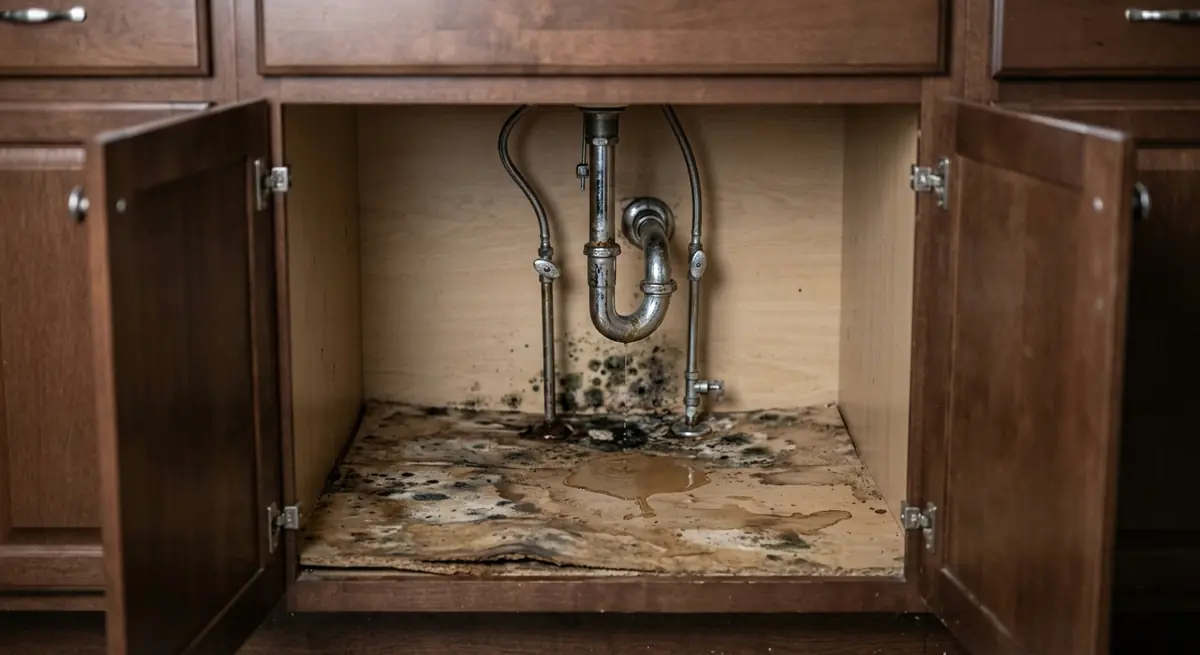
EPA says to fix plumbing leaks and other water problems as soon as possible. Supply and drain lines leak inside walls, under sinks and in crawl spaces.
3. Gutters and grading
EPA lists gutters and landscaping that direct water into the building. Water at the foundation reaches basements and crawl spaces.
4. High humidity
Humid indoor air supplies moisture without any leak. It gathers in bathrooms, kitchens, laundry rooms and closed-up spaces.
5. Condensation
Condensation forms where warm, moist air meets a cold surface, such as a window frame, a cooling coil or a duct.
6. Unvented combustion appliances
EPA lists unvented combustion appliances as a source, because they release moisture into the room air.
7. Deferred maintenance
EPA lists deferred maintenance. A small leak or a clogged drain left in place becomes the long-term wetting growth needs.
Flood and sewage water are separate cases. EPA says to hire a professional for sewage or contaminated water.
Where do these moisture sources show up in each room?
Each source leaves a pattern: roof leaks show in the attic and on ceilings, plumbing leaks under sinks and in walls, grading problems in the basement and crawl space, and humidity and condensation in bathrooms, closets and windows.
- Attic and ceilings: roof leaks and poor ventilation.
- Kitchen and under sinks: supply and drain leaks.
- Basement and crawl space: water directed toward the foundation.
- Bathroom: humidity, condensation and leaks around fixtures.
- Windows and closets: condensation on cold surfaces and still, humid air.
Bathrooms combine several sources at once, and our guide to mold in the bathroom covers them room-specifically.
How do you fix the moisture source?
Find the water, stop it, dry every wet item and hard surface completely, and only then clean or remove the mold. EPA says to fix plumbing leaks and other water problems as soon as possible, because cleaning does not stop a leak.
- Find the source: trace the stain, smell or damp spot back to the leak, the condensation or the humidity.
- Stop it: repair the roof, the pipe, the gutter or the ventilation.
- Dry: dry items and hard surfaces completely.
- Clean: scrub hard surfaces with detergent and water, and have larger areas handled by a specialist.
- Watch: check the spot after the work for new staining or smell.
Long-term habits that stop the water coming back are in our guide to keeping mold from coming back.
Does insurance cover the moisture source behind mold?
Homeowners insurance usually covers mold only when a sudden covered peril, such as a burst pipe, caused it. Flood, long-term leaks and humidity usually fall outside coverage, so the source of the moisture decides whether a claim pays.
This is why the cause matters on paper as well as in the wall. A sudden pipe burst and a slow drip behind a wall can produce identical mold, and a policy treats them differently. Help with insurance claims is part of the network's service.
How do you get help with mold from a moisture problem?
Call (856) 595-8837. A support manager confirms a booking time, and a local specialist from the independent network gives the free estimate and inspection on the call. Describe the leak, the humidity or the stain you found.
Humid and storm-prone cities in the network include mold remediation in Houston, Miami mold remediation and Hialeah mold remediation. Each city page lists the coverage area for the call. For wet-area cleanup after a leak or flood, see mold after water damage.
Mold causes FAQ
Can mold grow without a leak?
Yes. High indoor humidity and condensation on cold surfaces supply the moisture growth needs without any leak. Controlling humidity, ventilation and cold-surface condensation matters as much as repairing pipes and roofs, and it is the first thing to check.
What is the most common cause of mold in a house?
EPA lists roof leaks, gutters and landscaping directing water in, unvented combustion appliances and deferred maintenance, and says to fix plumbing leaks fast. No source ranks them, and any one of them supplies enough water for growth.
Does mold mean the house has a major problem?
Not always. A small area under about 10 square feet is usually a homeowner job, per EPA, once the water source is fixed. Large areas, sewage water, suspected HVAC contamination or health concerns call for a professional.
How fast does mold start after water damage?
Do not wait to dry. EPA says to dry items and hard surfaces completely and fix water problems as soon as possible. The exact hours depend on the material, and the specialist tells you on the call.
Do I need to know which mold I have?
No. CDC says you do not need to identify the type, because the response is the same: remove the mold and fix the moisture. CDC does not recommend mold testing, since no accepted standards define an acceptable level.
Found the moisture? Call (856) 595-8837. A support manager books your time, and a local specialist gives the estimate on the call.
Call (856) 595-8837