Mold Remediation in Toledo, OH
Mold remediation in Toledo, OH begins with a call to (856) 595-8837, answered by a support manager who books a time that suits you. A local specialist from our network then contacts you quickly, sometimes the same day, with the estimate on that call. The job runs from inspection and containment to removal of moldy material and the fix for water entering the basement, roof or plumbing.
- One call, no forms to fill out
- Support manager available 24/7 to confirm your booking time
- A specialist contacts you quickly, sometimes the same day
- Free estimate and inspection, given on the call
- Licensed, insured and certified network technicians
- Help with insurance claims
- Written warranty on the work
- Independent clearance testing available
Support manager answers · you confirm a booking time · the specialist gives the estimate on the call
No name, phone or email needed. We count anonymous answers, never contact details, to improve this page.
When you call, tell the support manager which level of the house is affected, roughly how many square feet, and when water last got in.
Mold Remediation Co. is a referral service. We connect you by phone with independent local mold remediation companies, and their technicians perform the work. We are not a contractor.
Quick recap
- For: Toledo property owners with a damp or moldy basement, a stain under a roof leak, or growth near a pipe.
- First step: a call to (856) 595-8837; the support manager confirms a booking time.
- Price: the local specialist's estimate, given on the call.
- Who does the work: independent network technicians who are licensed, insured and certified.
- Area: 15 Toledo ZIP (Zone Improvement Plan) codes plus Sylvania, Maumee, Perrysburg, Oregon, Rossford and 20 more nearby towns.
How does one call get mold handled in a Toledo home?
You call (856) 595-8837 and a support manager asks where the mold is, how much area it covers, and whether water came in recently. After you confirm a booking time, a local specialist contacts you quickly and gives the estimate on that call.
- Dial (856) 595-8837 and tell the support manager what you found.
- Pick a booking time and confirm it on the same call.
- Talk with the local specialist, who prices the job during that conversation.
Notes that speed up the estimate
- Which level of the house is affected: basement walls or floor, a top-floor ceiling under the roof, or a wall or cabinet beside a pipe.
- The rough size of each patch. The U.S. Environmental Protection Agency (EPA) treats patches under about 10 sq ft, roughly 3 ft by 3 ft, as a job most homeowners can handle; larger areas point to a professional.
- Whether the basement took floodwater or a sewage backup. EPA advises calling a professional experienced with contaminated water when sewage or other contaminated water caused the damage.
- Anyone in the household with asthma, a mold allergy, a weakened immune system or chronic lung disease, the groups the Centers for Disease Control and Prevention (CDC) describes as at higher risk.
- Whether the furnace or air handler smells musty. EPA advises against running a heating, ventilation and air conditioning (HVAC) system that you know or suspect is contaminated with mold.
Where does mold start in Toledo houses?
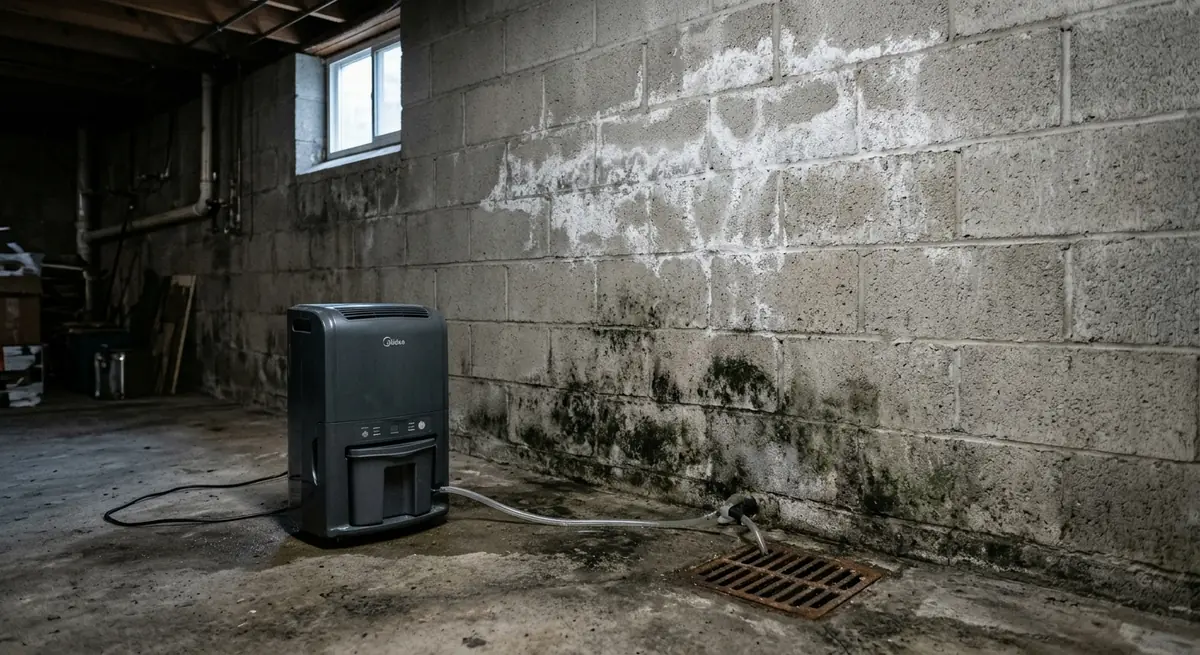
Basement moisture leads the list of Toledo mold sources: water that seeps through or collects at the foundation stays in a closed, cool room. Roof leaks and plumbing leaks come next, feeding growth in top-floor ceilings, attics and the walls around pipes.
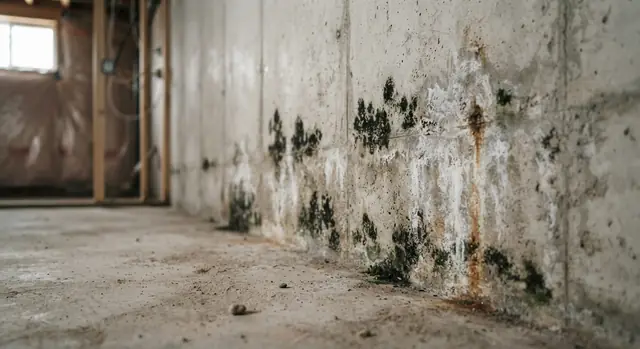
Basement mold
EPA's moisture advice for a house starts outside the foundation: the ground should slope away from the building so water does not enter or collect around it, and roof gutters need regular cleaning and repair. When either fails, a Toledo basement wall or floor stays damp, and stored boxes, carpet, paneling and finished drywall give mold something to feed on. EPA even pictures a suitcase growing mold in a humid basement. The specialist reads moisture in the walls and floor, traces where water gets in, and prices drying and removal together. Our guide to mold in the basement goes further into basement moisture control.
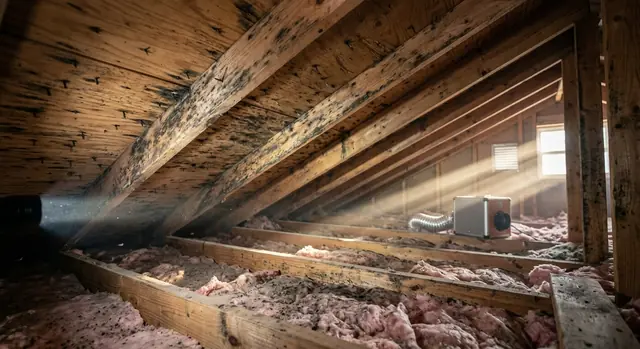
Roof-leak mold
CDC notes that mold grows where there is moisture, such as around leaks in roofs, and EPA lists roof materials above ceiling tiles as a hidden-mold spot caused by roof leaks or insufficient insulation. The Toledo Metcalf Field station averages 32.4 inches of precipitation a year, so a slipped shingle or a blocked gutter has regular chances to let water in. The specialist checks the stained ceiling, the attic sheathing above it and the insulation around it.
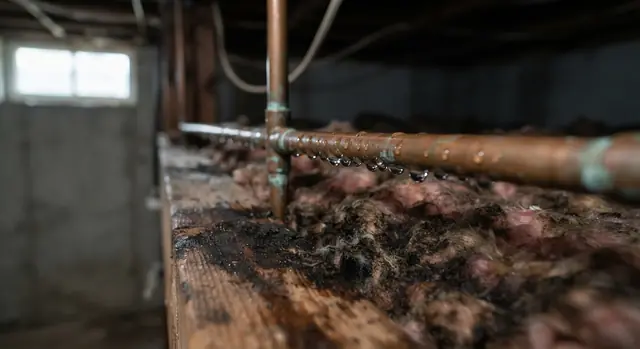
Plumbing-leak mold
EPA lists the inside of walls around leaking or condensing pipes as a hidden-mold location and tells homeowners to fix plumbing leaks as soon as possible. In a basement, supply and drain lines often run in the open along the ceiling joists, so a slow drip lands on framing, drywall or stored items below. EPA also advises covering cold surfaces, such as cold water pipes, with insulation to stop condensation.
How do Toledo's climate and flood record feed mold?
Toledo mold draws on 3 water sources: rain at the foundation, condensation through a long heating season, and floods. Toledo Metcalf Field averages 32.4 inches of precipitation a year, and Toledo ZIP codes have filed 877 flood insurance claims since 1978.
Precipitation at the foundation
The NOAA climate-normals station at Toledo Metcalf Field averages 32.4 inches of precipitation a year (1991-2020 normals) and is the nearest station for 12 of the 15 covered ZIP codes. The other 3, ZIP codes 43615, 43617 and 43623, sit nearest the Toledo Express Airport station, which averages 35.0 inches. Across Lucas County the average is 34.2 inches (NOAA nClimDiv, 1991-2020). EPA's answer to that water is outside the house: ground graded away from the foundation and gutters kept clean and in repair.
Cold months, cold basement walls
A heating degree day measures how far a day's mean temperature sits below 65°F. Toledo Metcalf Field logs about 5,840 heating degree days a year against about 930 cooling degree days, so heating demand runs roughly 6 times cooling demand; Toledo Express Airport logs about 5,640. Through those months, foundation walls, cold-water lines and window glass stay cool, and EPA treats condensation on windows, walls or pipes as a sign of high humidity to dry and correct quickly.
Flood claims and storm declarations
The National Flood Insurance Program (NFIP) records 877 claims from Toledo's 15 covered ZIP codes since 1978, and 18 of them since 2016. Four ZIP codes account for 600: 43612 with 172, 43611 with 169, 43609 with 146 and 43613 with 113. Every covered ZIP code has at least 1 claim on record. Lucas County has been named in 3 federal major disaster declarations since 2000, all for severe storms (data as of 09/25/2025). NFIP counts reflect insured properties only, so a low count is not a low flood risk.
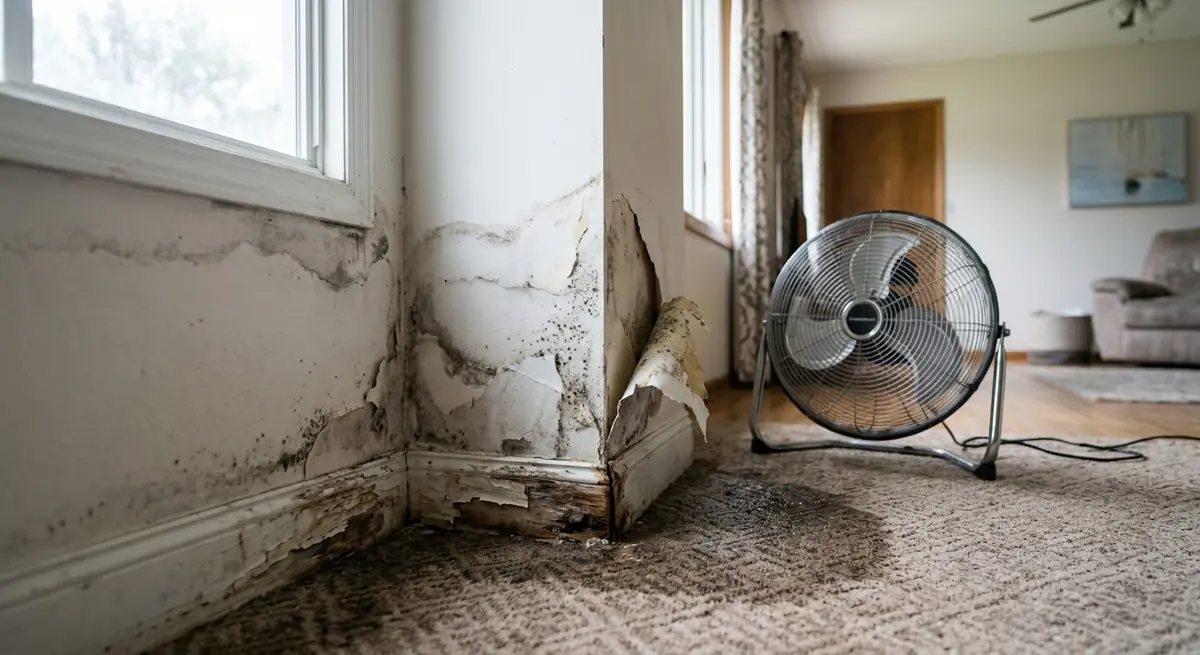
After any flood or leak the clock is short. EPA advises drying water-damaged areas and items within 24 to 48 hours to prevent mold growth, and its water-damage table applies the same window to wet carpet and its backing, adding that the subfloor beneath must be cleaned and dried as well.
Which materials does Toledo basement mold damage?
Toledo basement mold damages 5 materials: concrete and block walls, carpet and pad, drywall and paneling, wood framing, and insulation. Concrete is dried and cleaned in place, while wet insulation, swollen drywall and carpet that mold has filled come out.
- Concrete and cinder block
EPA's water-damage table removes the water with an extraction vacuum and speeds drying with dehumidifiers, fans or heaters. Block and poured walls stay in place and are scrubbed and dried.
- Carpet and pad
EPA lists the underside of carpets and pads as a hidden-mold location and says porous materials such as carpet may have to be thrown away once moldy. The subfloor below gets cleaned and dried too.
- Drywall and paneling
EPA's table allows drywall to dry in place only with no obvious swelling and intact seams; otherwise it is removed and replaced. Wet paneling is pried away from the wall so the cavity behind it dries.
- Wood framing
Basement studs, sill plates and joists are dried at once with dehumidifiers, gentle heat and fans, per EPA. Treated or finished wood can be cleaned with mild detergent and water.
- Insulation
EPA's table lists wet fiberglass and cellulose insulation for discard and replacement, so insulation behind a finished basement wall comes out once it has soaked.
What are Ohio's rules for mold remediation?
Ohio's Department of Health offers mold cleanup guidance, and we have not found a state mold-specific license. For a Toledo job, that puts the written contract in charge of scope, containment and who checks the result, so read it before work starts.
The Ohio Department of Health (ODH) publishes its guidance through the Healthy Homes Program page "Emergency Flood Cleanup and Mold". Confirm any rule with the agency before relying on it for a specific property.
Without a state mold credential to look up, EPA's own hiring advice carries the weight: choose a contractor with experience in mold work and check references. Ask the Toledo specialist to put the containment level, the materials to remove and the clearance check into the written scope. Statewide coverage, and how the rules apply outside Toledo, are on our page about mold remediation across Ohio.
What are the steps of mold remediation in a Toledo basement?
A Toledo mold job moves through 6 steps: find the growth and its water source, seal off the work area, filter the air with high-efficiency particulate air (HEPA) machines, remove or clean materials, stop the water, and confirm the area is clean.
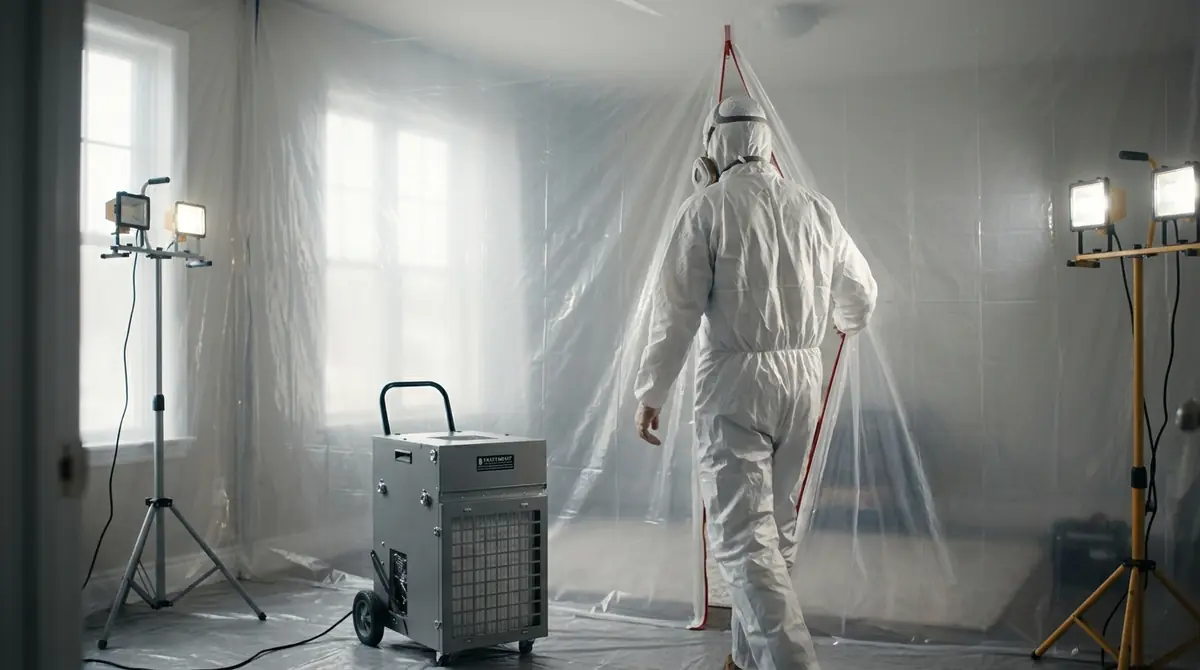
- Find: the specialist maps growth on walls, floor and stored items, reads moisture in concrete, drywall and wood, and locates where water gets in.
- Seal: plastic sheeting closes the work area off from the rest of the house; EPA sets limited containment for 10 to 100 sq ft and full containment beyond 100 sq ft.
- Filter: HEPA air machines run while the work goes on, and HEPA vacuums clean surfaces once materials are dry.
- Remove or clean: wet insulation, swollen drywall and moldy carpet are bagged and carried out; concrete, block and sound wood are scrubbed with detergent and water and dried.
- Stop the water: the grading, gutter, roof or pipe problem that wet the area gets repaired, by the remediation company or by the trade that handles it.
- Confirm: the area is checked for remaining growth and dampness before anything is rebuilt.
Sewage changes the job. EPA's water-damage table notes that the Occupational Safety and Health Administration (OSHA) requires protective equipment and containment when the water is contaminated with sewage or other pollutants, and it advises against running fans until the water is known to be clean.
Should a Toledo basement be tested for mold first?
No lab test is needed when mold is visible. CDC does not recommend mold testing, and every type of growth is removed the same way. A visual inspection with moisture readings finds the growth and the water behind it, which sets the scope.
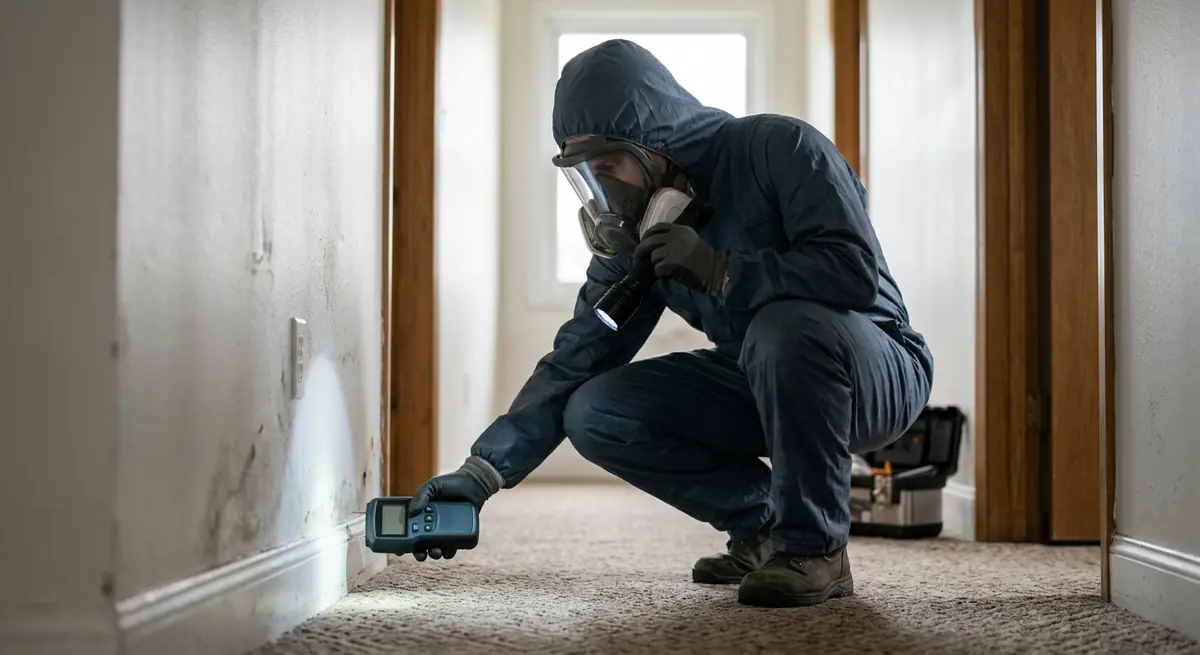
Samples earn their cost in 2 cases: a musty basement with nothing visible, where they help locate growth behind paneling or under carpet, and the end of a job, where they help confirm clearance. CDC adds that sampling cannot tell you whether someone might become sick. What the inspector checks, room by room, and how clearance works are on our page about mold inspection in Toledo.
What sets the price of mold remediation in Toledo?
Square footage sets the base price of a Toledo mold job, and containment, tear-out of finished basement materials, the water-source repair and clearance testing add to it. No verified Toledo range was found; your number comes from the specialist's estimate.
A finished basement costs more to remediate than bare concrete of the same size: drywall, carpet and insulation come out now and go back in later, while concrete is dried and cleaned where it stands. No verified Toledo price range was found on 11/12/2026, so our cost page shows HomeAdvisor's national range, labeled national.
Lines a Toledo quote should show
- Square feet of growth for each area: basement walls, basement floor, ceilings, other rooms
- Containment level and the number of HEPA machines
- Every material removed, and every surface cleaned and dried
- How the water entry gets stopped, and which trade does it
- Who performs clearance, and what counts as a pass
Warning signs
- A price set by the color of the mold instead of the area and materials. CDC sees no need to identify the type.
- No plan for the water that caused the growth.
- One company removing the mold and grading its own clearance, with no independent check offered.
- Payment demanded in cash, or in full, before work starts.
National price figures with their sources and a full line-item list are on our page about mold removal cost in Toledo.
How do you know a Toledo mold job is done?
A Toledo mold job is done when water no longer reaches the area, the remaining materials read dry, and an independent clearance check finds no visible growth or mold odor. Cleaning without stopping the water leaves the mold free to return.
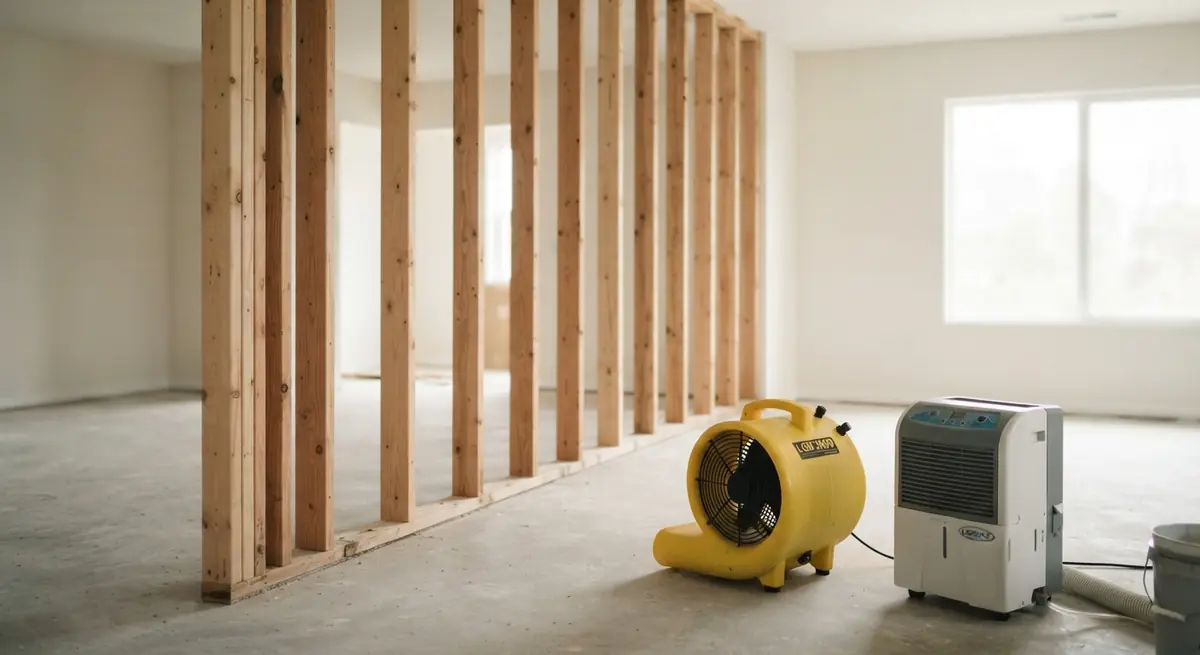
EPA's cleanup page warns that mold cleaned up without a fix for the water problem will most likely come back. In a Toledo basement that means the grading, gutter, leaking pipe or roof is repaired before new drywall, carpet or insulation goes in. EPA's indoor humidity target, below 60 percent and ideally 30 to 50 percent, gives a dehumidifier a number to hold afterward. Get the clearance result in writing before the rebuild starts.
Which Toledo ZIP codes and nearby towns does the network cover?
The network covers 15 Toledo ZIP codes: 43604 through 43615, plus 43617, 43620 and 43623. It also takes calls from 25 nearby towns, among them Sylvania, Maumee, Perrysburg, Oregon, Rossford, Northwood, Holland, Waterville, Whitehouse and Bowling Green.
| Town | Covered ZIP codes |
|---|---|
| Rossford | 43460 |
| Oregon | 43616 |
| Northwood | 43619 |
| Sylvania | 43560 |
| Maumee | 43537 |
| Walbridge | 43465 |
| Harbor View | 43434 |
| Holland | 43528 |
| Perrysburg | 43551 |
| Millbury | 43447 |
| Stony Ridge | 43463 |
| Monclova | 43542 |
| Berkey | 43504 |
| Waterville | 43566 |
| Dunbridge | 43414 |
| Haskins | 43525 |
| Whitehouse | 43571 |
| Luckey | 43443 |
| Tontogany | 43565 |
| Neapolis | 43547 |
| Pemberville | 43450 |
| Bowling Green | 43402, 43403 |
| Grand Rapids | 43522 |
| Bradner | 43406 |
| Weston | 43569 |
Calling from a ZIP code that is not on the list? The support manager checks on the call whether a specialist covers it.
Toledo mold remediation FAQ
How soon does a Toledo mold specialist get in touch?
Quickly, and sometimes the same day. The support manager, available 24/7, confirms a booking time first; the local specialist then contacts you and gives the estimate on that call, so price and scheduling are settled in one conversation.
Can a wet Toledo basement be saved from mold?
It can be, when it dries fast. EPA advises drying water-damaged areas and items within 24 to 48 hours to prevent mold growth. Extract the water, run dehumidifiers and fans, and dry the subfloor under any carpet as well.
Who should clean up after a sewage backup in a Toledo basement?
A professional with experience in contaminated water. EPA advises calling one when sewage or other contaminated water caused the damage, and its water-damage table notes that OSHA requires protective equipment and containment. Keep fans off until the water is confirmed clean.
Does running a dehumidifier get rid of basement mold?
No. A dehumidifier holds humidity down, and EPA's target is below 60 percent, ideally 30 to 50 percent, but existing growth still has to be cleaned or removed. Run it after the water entry is fixed and the mold is gone.
Do I need to know which mold is growing before I call?
No. CDC states there is no need to identify the type of mold, because every kind is removed and the moisture fixed in the same way. Tell the support manager where the growth is and how large it looks instead.
Damp basement, roof leak or pipe leak with mold in Toledo? Call (856) 595-8837. The support manager books a time, and a local specialist contacts you with the estimate.
Call (856) 595-8837