Mold Remediation in Denver, CO
Mold remediation in Denver, CO begins with a call to (856) 595-8837, where a support manager confirms a booking time. A local specialist from our network then reaches you quickly, sometimes the same day, and prices the job on that call. Most Denver mold starts in the attic, where winter condensation and roof leaks wet the sheathing, or in a damp basement, so the fix covers removal and the water source.
- One call, no forms to fill out
- Support manager available 24/7 to confirm your booking time
- A specialist contacts you quickly, sometimes the same day
- Free estimate and inspection, given on the call
- Insured and certified network technicians
- Help with insurance claims
- Written warranty on the work
- Independent clearance testing available
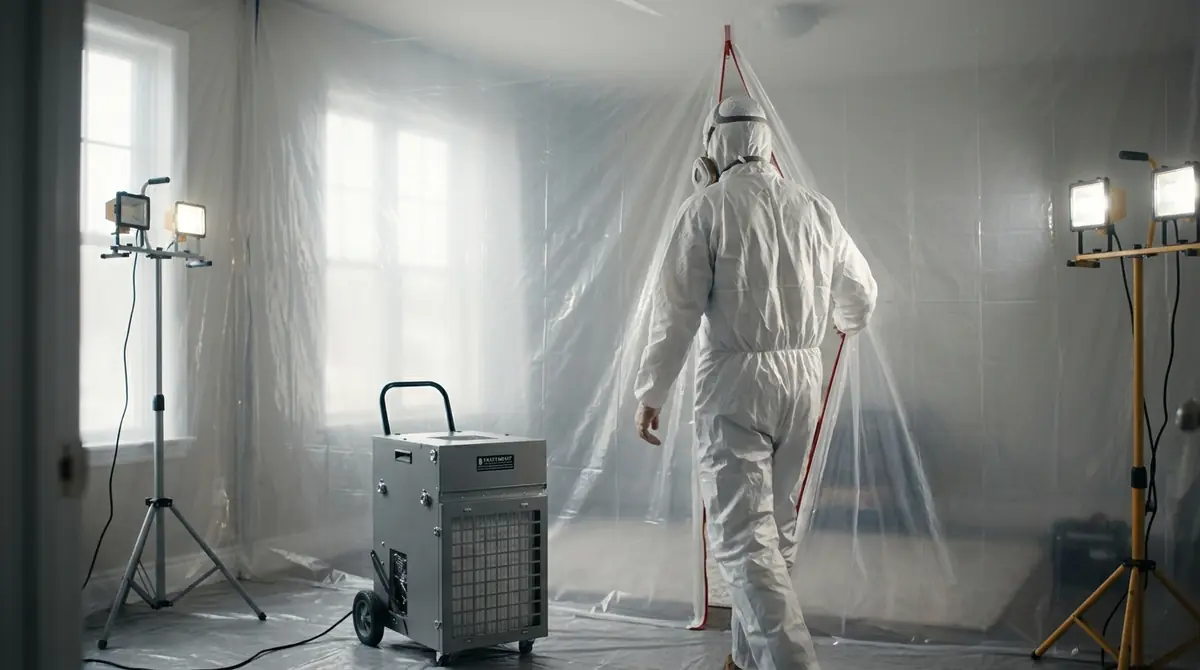
Support manager first · booking time confirmed · estimate from the Denver specialist on the call
No name, phone or email needed. We count anonymous answers, never contact details, to improve this page.
On the call, name the room, the rough size of the stained area, and when the last leak, roof drip or flood happened.
Mold Remediation Co. is a referral service. We connect you by phone with independent local mold remediation companies, and their technicians perform the work. We are not a contractor.
Quick recap
- Who calls: Denver owners with attic staining, a damp basement, a musty odor, or water from a recent leak.
- First contact: a support manager at (856) 595-8837 confirms a booking time.
- Price: the local specialist gives the estimate on the call.
- Who does the work: independent network technicians who are insured and certified.
- Area: 39 Denver ZIP (Zone Improvement Plan) codes plus Commerce City, Dupont, Henderson and Brighton.
What happens when you call about mold in Denver?
A support manager takes the call at (856) 595-8837, notes where the mold is and any recent leak, and confirms a booking time. A local specialist then contacts you quickly, sometimes the same day, and gives the estimate on that call.
- Dial (856) 595-8837 and tell the support manager what you found and where.
- Pick the booking time the support manager confirms with you.
- Hear the Denver specialist's estimate on the follow-up call.
Notes that speed up a Denver estimate
- Attic: dark patches on the underside of the roof deck, or insulation that looks damp or matted.
- Basement: the wall or floor that stays damp, and whether drywall or carpet covers it.
- Size: length times width of each patch. The U.S. Environmental Protection Agency (EPA) treats about 10 sq ft as the limit for homeowner cleanup.
- Health: anyone at home with asthma, a mold allergy, a weakened immune system or chronic lung disease, the groups the Centers for Disease Control and Prevention (CDC) lists as higher risk.
- Furnace: a musty smell from the registers. EPA advises against running a heating and cooling system you know or suspect holds mold.
Where does mold start in Denver houses?
Denver mold starts in 3 places: the attic, where warm air escaping the house condenses on cold roof sheathing or a roof leak soaks it; the basement, where foundation dampness wets finished walls; and wall cavities around leaking supply and drain lines.
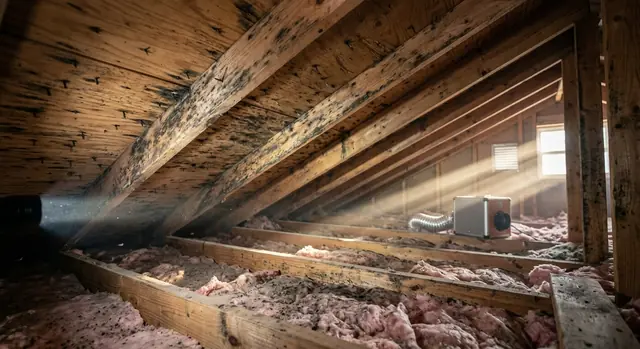
Attic sheathing
Winter in Denver keeps the roof deck cold for months. Warm, moist house air that leaks through ceiling gaps, light fixtures or an unsealed hatch condenses on that deck, and EPA ties mold in roof materials to roof leaks or insufficient insulation. The specialist checks the sheathing, rafters and insulation, then traces every moisture outlet that ends in the attic. EPA advises venting moisture-producing appliances such as clothes dryers to the outside. Our guide to mold in the attic covers ventilation and insulation fixes in detail.
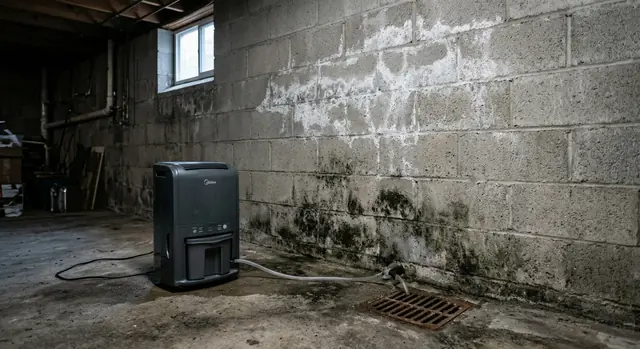
Basement walls and carpet
A Denver basement stays cooler than the rooms above it, and a foundation wall that takes on water from outside keeps the drywall and carpet against it damp. EPA lists the underside of carpets and pads and the back side of drywall among the places mold hides. EPA also advises grading the ground so it slopes away from the foundation, so water does not collect around it.
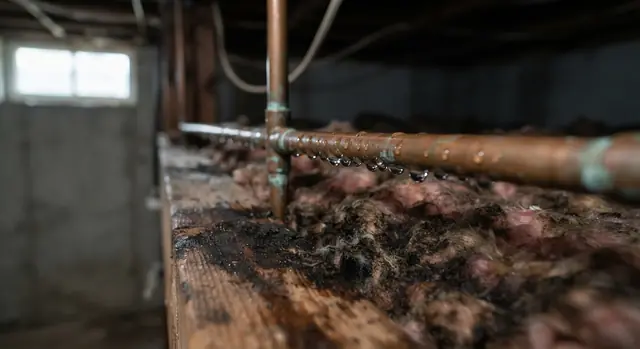
Leaks around pipes
A slow drip from a supply line or drain soaks the wall cavity long before a stain shows. EPA names the inside of walls around pipes as a common hidden-mold spot and tells owners to fix plumbing leaks as soon as possible. The specialist reads moisture levels first and opens drywall only where the readings point.
How does Denver's climate lead to indoor mold?
Denver's climate leads to indoor mold through cold, not rain. The Denver Water Dept station averages 15.8 inches of precipitation and about 5,260 heating degree days a year, so condensation on cold surfaces, leaks and floods supply the water.
Heating demand outweighs cooling
A heating degree day measures how far a day's mean temperature sits below 65°F. The Denver Water Dept normals station, at about 5,230 ft, records about 5,260 heating degree days and 1,045 cooling degree days a year (1991-2020 normals), so heating demand is about 5 times cooling demand. East Denver ZIPs read from the Denver-Stapleton station, at about 5,765 heating degree days, and the west-side ZIPs that use the Lakewood station read about 5,910. Denver County as a whole averages about 5,763 (NOAA nClimDiv, 1991-2020).
Cold roof decks, cold foundation walls and cold-water pipes are where that heating season shows up as mold. EPA names condensation as a sign of high humidity and recommends covering cold surfaces, such as cold-water pipes, with insulation. EPA's indoor target is relative humidity below 60 percent, ideally between 30 and 50 percent.
Precipitation by station
Precipitation across Denver's covered ZIPs runs from 15.4 inches at Denver-Stapleton to 17.9 inches at the Denver 1 SW 7NEWS station and 19.8 inches at Lakewood 1.7 SW, which serves ZIP 80228. Denver County averages about 15.1 inches (NOAA nClimDiv, 1991-2020).
Flood claims cluster on the west side
Property owners in Denver's 39 residential covered ZIP codes have filed 500 National Flood Insurance Program (NFIP) claims since 1978, 77 of them since 2016. ZIP 80214 accounts for 97 of those claims, 80215 for 42 and 80226 for 36. Denver County has been named in 2 federal major disaster declarations since 2000, and both were floods. ZIPs 80230, 80235, 80247 and 80290 show no NFIP claims; that record counts insured losses only and is not a flood-risk rating. EPA's drying window after a leak or flood is 24 to 48 hours.
Which materials does attic and basement mold damage in Denver?
Attic and basement mold in Denver damages 5 materials: roof sheathing, attic insulation, finished basement drywall, carpet with its pad, and concrete foundation walls. Porous materials filled with growth come out; concrete and other hard surfaces are scrubbed and dried.
- Roof sheathing
The roof deck sits right under the shingles, so warm attic air meets it first in winter. Stained sheathing is cleaned when the wood is sound and replaced when the growth or a roof leak has weakened it.
- Attic insulation
Fiberglass and cellulose hold condensate against the ceiling below. EPA's water-damage table lists both for discard and replacement once wet, rather than drying in place.
- Basement drywall
Gypsum board in a finished basement wicks water up from a damp slab or wall. EPA treats moldy drywall as porous material that is removed, because growth inside it cannot be fully cleaned out.
- Carpet and pad
EPA lists the underside of carpets and pads as a hidden-mold location, and notes that porous materials such as carpet often have to be thrown away once moldy.
- Concrete walls
Poured or block foundation walls are non-porous enough to keep. The surface is scrubbed with detergent and water and dried, and the water path through or around the wall is fixed.
Does Colorado license mold remediation companies?
We have not found a Colorado state mold-specific license; contractor licensing is handled at the city or county level in many places, so check with your local building department. Ask the Denver specialist whether a local permit applies before demolition starts.
No official Colorado agency statement on mold licensing turned up in our research, so this page states no state rule beyond that. The checks that matter for a Denver job are local: whether the tear-out or rebuild needs a permit from the city building department, and what written scope the company signs before work starts.
Statewide context, including the other Colorado cities our network covers, is on our page about mold remediation across Colorado.
What steps does Denver mold remediation follow?
Denver mold remediation follows 6 steps: assess the growth and moisture, seal the work area, filter the air through high-efficiency particulate air (HEPA) machines, remove or clean affected materials, repair the water source, and verify the area is clean and dry.
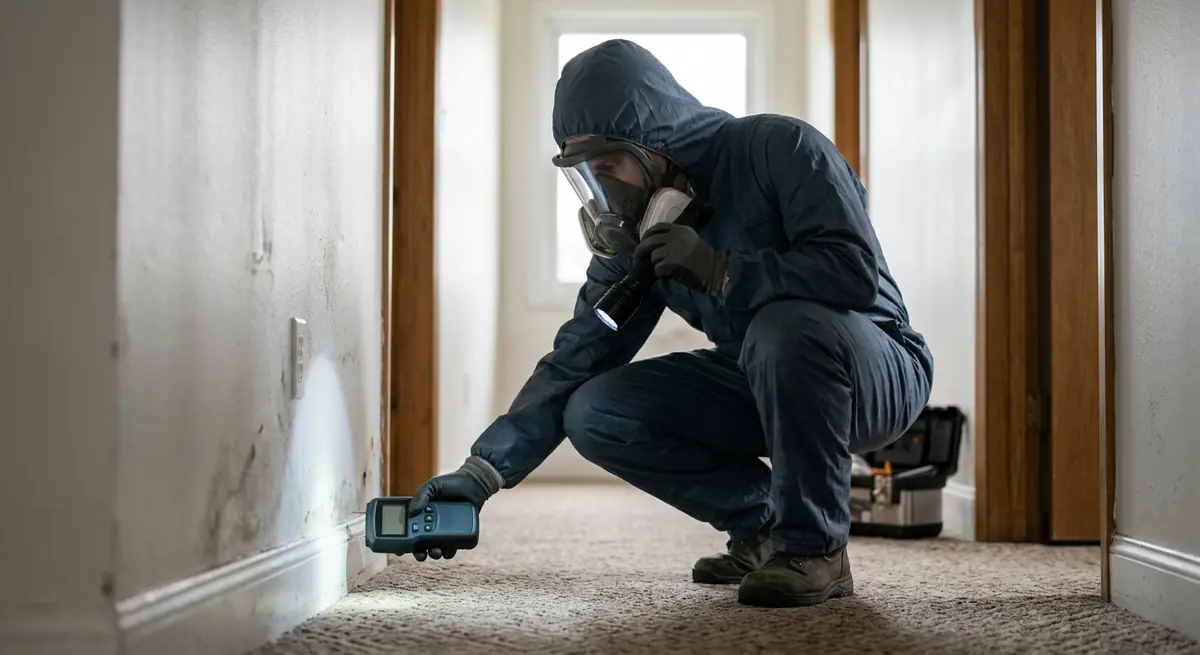
- Assess: moisture readings and a visual survey map the growth in the attic, basement or wall, and locate the water source.
- Seal: plastic sheeting encloses the area. EPA sets limited containment for 10 to 100 sq ft and full containment above 100 sq ft.
- Filter: HEPA air units run during the work; HEPA vacuums clean dry surfaces afterward.
- Remove: porous materials full of growth leave in sealed bags; hard surfaces are scrubbed with detergent and water.
- Repair: the roof leak, attic air leak, foundation seepage or pipe that fed the mold is corrected.
- Verify: the area is checked for remaining growth and moisture before new materials go in.
Do Denver homes need mold testing before removal?
Denver homes need a visual inspection with moisture readings before removal, not a lab test. CDC does not recommend mold testing, because no accepted standard defines a safe indoor level. Visible growth comes out whatever its species.
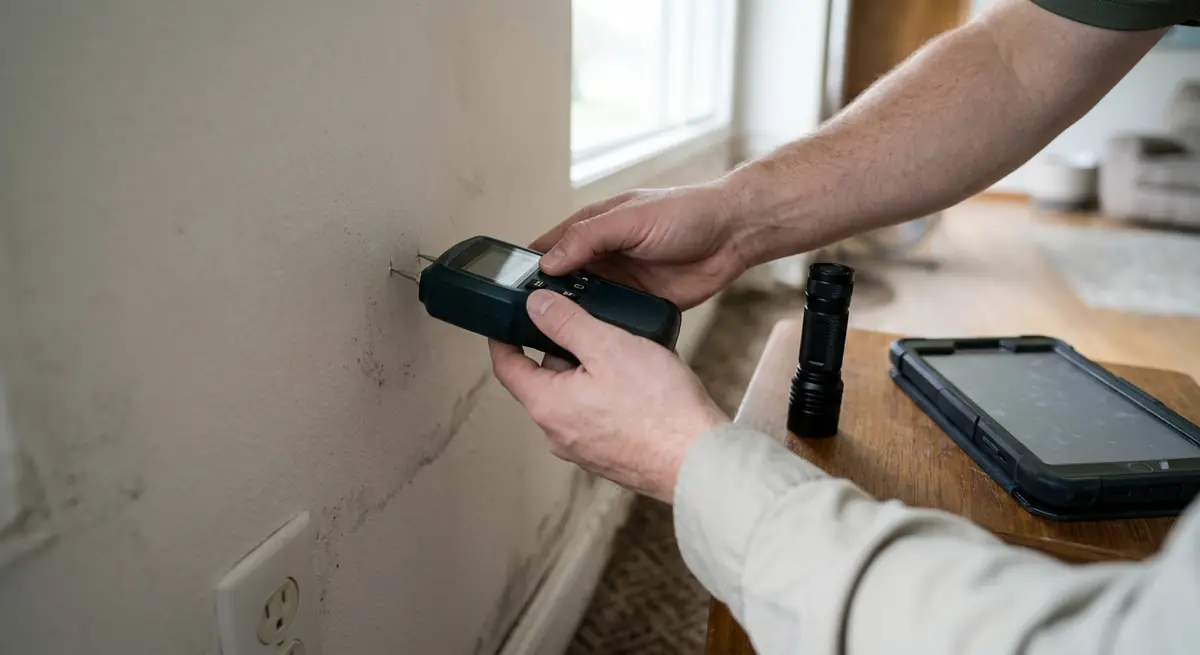
Lab sampling earns its fee in 2 Denver situations: a musty basement or closet with no visible source, where samples help find hidden growth, and the end of a job, where samples support clearance. EPA states that sampling is unnecessary in most cases where mold is visible. Fees, sampling methods and the assessor checklist are on our page about mold inspection in Denver.
What sets the price of mold remediation in Denver?
Square footage sets the base price of Denver mold remediation. Attic or basement access, the containment level, materials torn out, the roof, foundation or plumbing repair, and clearance testing raise or lower it. The local specialist gives your estimate on the call.
An attic job needs insulation moved before the sheathing is reached, and every bag of debris leaves through the hatch. A finished basement adds drywall, carpet and trim to remove and later replace. National price figures (no verified Denver range was found) and line-by-line drivers are on our page about mold removal cost in Denver.
Lines a complete Denver quote shows
- Square feet of growth in each room, with the attic and basement measured apart
- Containment level and the number of HEPA units
- Each material removed and each surface cleaned
- Roof, attic-ventilation, foundation-drainage or plumbing repair, or the trade that handles it
- Clearance check, with the company that performs it
Warning signs in a quote
- A single total with no square footage or line items.
- Clearance performed only by the company that did the removal.
- A price raised because the mold looks black, though CDC finds no need to identify the type.
How do you know a Denver mold job is finished?
A Denver mold job ends when the water source is repaired, materials read dry, and a clearance check finds the area clean. EPA states that mold cleaned without fixing the water problem comes back, so the repair belongs to the job.
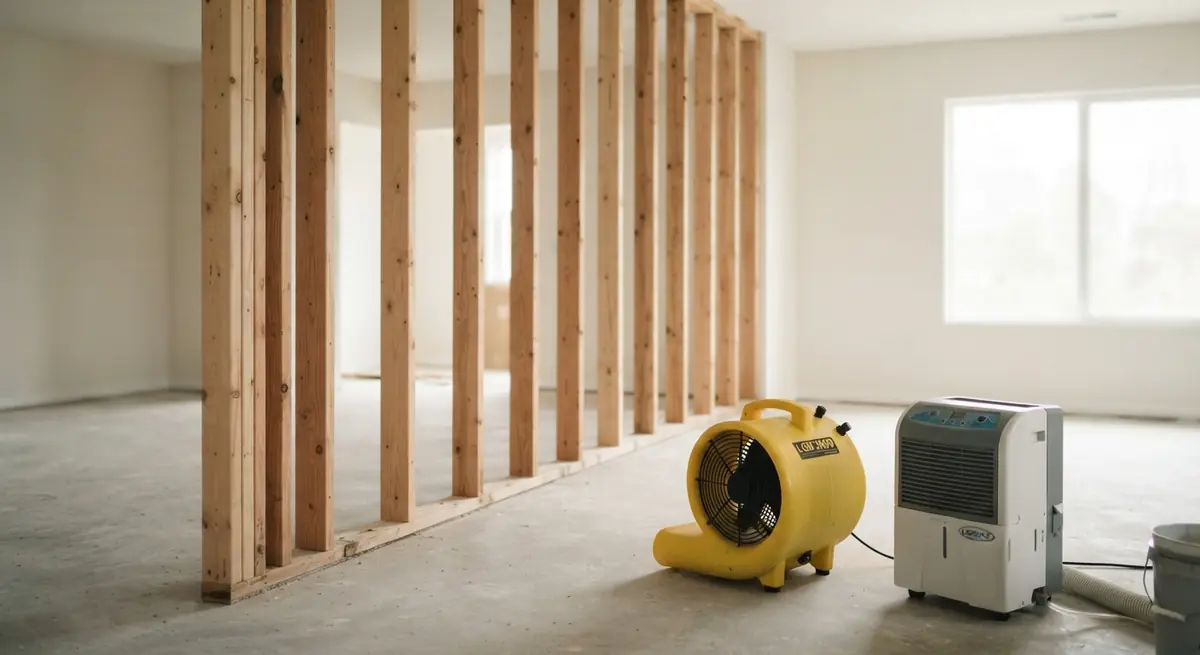
For a Denver attic, finished means the roof leak is sealed or the warm-air leaks from the house are closed, the dryer and other moisture-producing appliances vent outdoors, and new insulation goes in only after the deck reads dry. For a basement, it means water no longer reaches the wall, the slab and framing are dry, and the clearance result is in writing before new drywall or carpet is installed. Water-damaged areas dried within 24 to 48 hours, the window EPA gives, keep the next leak from becoming the next mold job.
Which Denver ZIP codes and nearby towns does the network cover?
Our network covers 39 Denver ZIP codes, among them 80202, 80210, 80214, 80220, 80237 and 80249, each listed in full below. Calls from 4 nearby towns in the Denver area are covered as well: Commerce City, Dupont, Henderson and Brighton.
Covered Denver ZIP codes: 80202, 80203, 80204, 80205, 80206, 80207, 80209, 80210, 80211, 80212, 80214, 80215, 80216, 80218, 80219, 80220, 80221, 80222, 80223, 80224, 80226, 80227, 80228, 80229, 80230, 80231, 80232, 80233, 80234, 80235, 80236, 80237, 80238, 80239, 80246, 80247, 80249, 80260 and 80290.
| Town | Covered ZIP codes |
|---|---|
| Commerce City | 80022 |
| Dupont | 80024 |
| Henderson | 80640 |
| Brighton | 80601, 80602, 80603 |
The support manager confirms coverage for any ZIP code not shown here during the call.
Denver mold remediation FAQ
Does Denver's dry climate keep mold out of houses?
No. The Denver Water Dept station averages only 15.8 inches of precipitation a year, but mold feeds on indoor water: roof leaks, pipe drips, basement seepage and condensation. EPA's indoor target is relative humidity below 60 percent.
Is it safe to run the furnace when the vents smell musty?
No. EPA advises against running a heating, ventilation and air conditioning system you know or suspect is contaminated with mold, because it spreads spores through the house. Switch it off and mention the smell when you call.
Does finished basement drywall come out after a leak in Denver?
Drywall with mold growth comes out, because EPA calls mold in porous material difficult or impossible to remove completely. Drywall dried within 24 to 48 hours, with no swelling and intact seams, stays in place under EPA's water-damage table.
Does flood insurance cover mold in a Denver basement?
No, in most cases. FEMA states that National Flood Insurance Program policies exclude mold damage, except where officials barred entry to the property or floodwater kept the owner from reaching it. Start drying and documenting right after the water recedes.
Do I need to know which mold species is growing before I call?
No. CDC states there is no need to identify the type of mold growing in a home. Every species is removed with the same containment and cleanup steps, and the specialist prices the job by area, access and materials.
Mold in a Denver attic, basement or wall? Call (856) 595-8837. A support manager confirms your booking time, and a local specialist gives the estimate on the call.
Call (856) 595-8837