Mold Inspection in Dallas, TX
Book a mold inspection in Dallas, TX by calling (856) 595-8837. A support manager confirms a booking time, and a local specialist from our network contacts you quickly, sometimes the same day, with the estimate on that call. The inspection follows moisture from the air handler, coil and ducts to ceilings and bathrooms, and lab samples are added only to find hidden mold or to confirm clearance.
- One call, no forms to fill out
- Support manager available 24/7 to confirm your booking time
- A specialist contacts you quickly, sometimes the same day
- Free estimate, given on the call
- Inspection-only calls are accepted
- Licensed, insured and certified network technicians
- Help with insurance claims
- Independent clearance testing available
Tell the support manager what you notice · agree a time · get the inspection estimate on the specialist's call
No name, phone or email needed. We count anonymous answers, never contact details, to improve this page.
On the call, describe the smell or stain, the rooms or vents involved, and how long it has been there.
Mold Remediation Co. is a referral service. We connect you by phone with independent local mold inspection and remediation companies, and their technicians perform the work. We are not a contractor.
Quick recap
- Who it suits: Dallas owners with musty vents, a ceiling stain, a past leak, or a finished mold job that needs clearance.
- What gets checked: air handler, coil, drain pan, ducts, attic, ceilings, bathrooms and any room you name.
- Texas rule: mold assessors hold their own TDLR license and work apart from the remediation firm.
- Lab samples: for hidden growth or clearance, not to name the species of visible mold.
- Booking: one call to (856) 595-8837 covers 48 Dallas ZIP codes and 8 nearby towns.
Mold inspection or mold test: which does a Dallas home need?
A Dallas home needs the inspection first: a visual and moisture survey that locates growth and the water feeding it. Lab testing comes second, for hidden mold or clearance, and EPA calls sampling unnecessary in most cases where mold is visible.
| Question | Inspection | Lab test |
|---|---|---|
| Where is the mold growing? | Yes: visual survey and moisture readings room by room | Only for the spots sampled |
| What water is feeding it? | Yes: traces the leak, drain fault or condensation | No |
| How large is the affected area? | Yes: square feet per room or duct run | No |
| Is hidden growth behind a musty odor? | Points to the likely cavity or duct | Yes: air or surface samples confirm it |
| Did the cleanup pass? | Yes: visual, odor and moisture check | Yes: samples read against outdoor air |
| Is the indoor level "safe"? | No federal benchmark exists | No: EPA has set no limits for airborne mold |
Most Dallas inspection calls start with a symptom rather than a stain: a sour smell when the air conditioner starts, dark dots on a ceiling register, or a damp ring on the floor of the air handler closet. Our guide to signs of mold in a house lists the clues worth mentioning when you book.
How do you book a Dallas mold inspection by phone?
Call (856) 595-8837 and tell the support manager what you notice, where, and for how long; the manager then confirms a booking time. A local specialist contacts you quickly, sometimes the same day, and states the inspection estimate during that call.
- Report the smell, stain or leak to the support manager.
- Pick the booking time that suits you.
- Hear the inspection and sampling estimate on the specialist's call.
Before the inspector arrives
- Leave the air conditioner off when the vents smell musty; EPA advises against running a system you suspect is contaminated.
- Clear the path to the air handler closet, the attic hatch and the water heater.
- Leave stains unpainted and uncleaned; EPA warns against painting or caulking over moldy surfaces.
- List the dates of roof repairs, AC service visits, plumbing leaks and storm damage.
- Say on the call whether this is a first inspection or a clearance visit after removal.
What does a mold inspector check in a Dallas home?
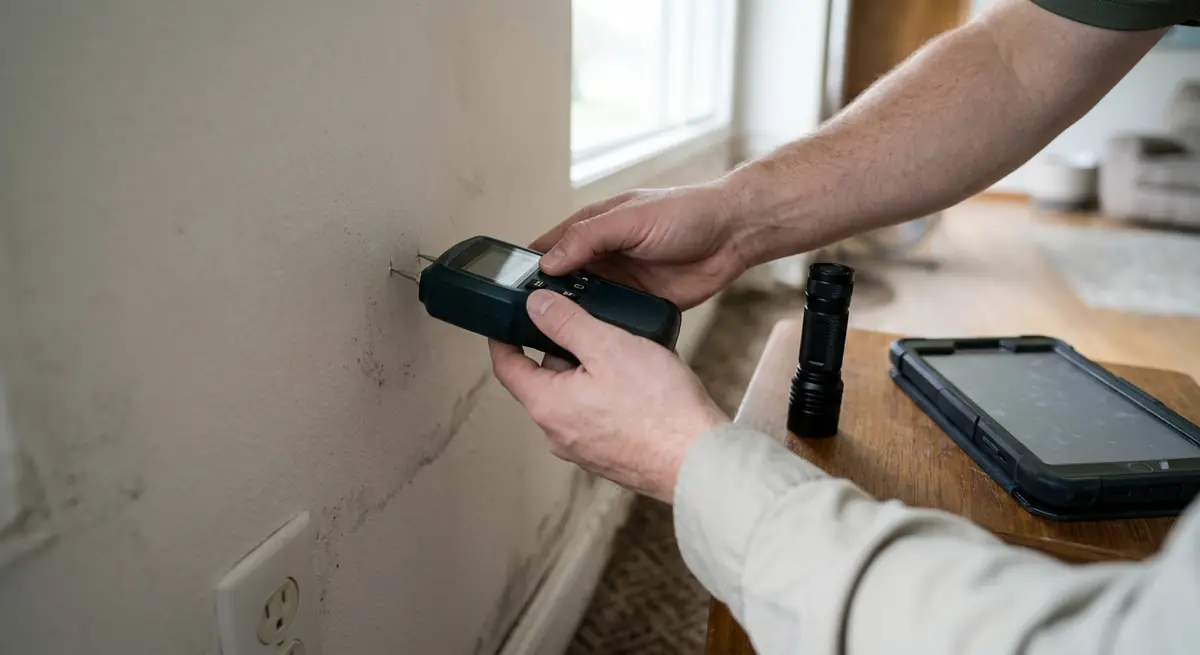
A Dallas mold inspector checks the cooling system first, then ceilings below the roof, bathrooms, plumbing walls and windows. At each spot the inspector records visible growth, moisture content, indoor humidity and the water source, and those findings set the remediation scope.
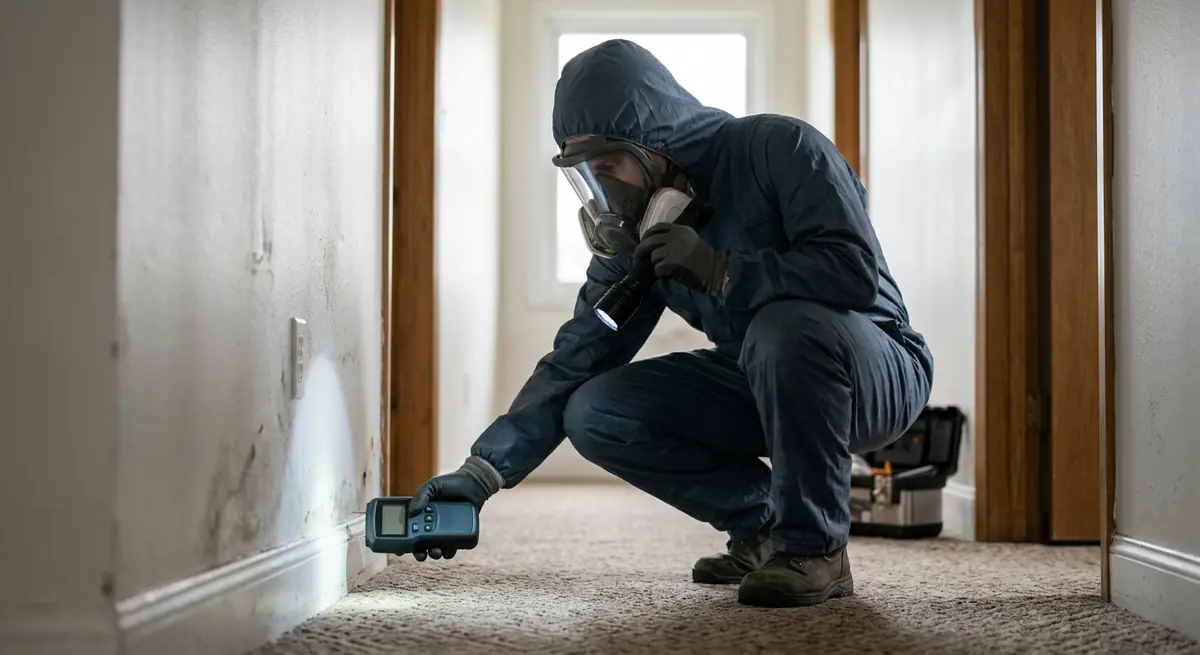
| Area | What the inspector checks | Why it is on a Dallas list |
|---|---|---|
| Air handler and coil | Evaporator coil, drain pan, condensate line and trap, closet floor and walls | EPA names condensation on or near cooling coils as a major factor in duct moisture problems |
| Ducts and registers | Duct liner, flexible duct jackets, supply boots, return grille, vent covers | Dallas Love Field logs about 3,125 cooling degree days a year, so cold supply air runs for months |
| Attic and ceilings | Roof decking, insulation, attic duct runs, ceiling drywall under stains | EPA lists roof materials above ceilings as a hidden-mold location after roof leaks |
| Bathrooms | Ceiling paint, grout, caulk, the wall behind the tub or shower, the exhaust fan | EPA notes that places that stay damp are hard to keep free of mold |
| Windows and outside walls | Sills, frames, wall surfaces behind furniture | EPA lists walls behind furniture, where condensation forms, as a hidden-mold location |
Humidity is part of the reading
EPA's target for indoor relative humidity is below 60 percent, ideally 30 to 50 percent. A Dallas inspector reads it in several rooms, because an air conditioner that cools the house without drying it leaves damp air to settle on cold registers and duct boots. EPA's duct guidance calls condensation or high relative humidity an important indicator of potential mold growth in ducts.
Written findings
Request a written report: each affected area with its size in square feet, the moisture and humidity readings, the water source and any lab results. Under Texas rules, a TDLR-licensed mold assessment consultant turns those findings into the remediation protocol that a separate remediation contractor follows.
When does a mold test pay off in Dallas?
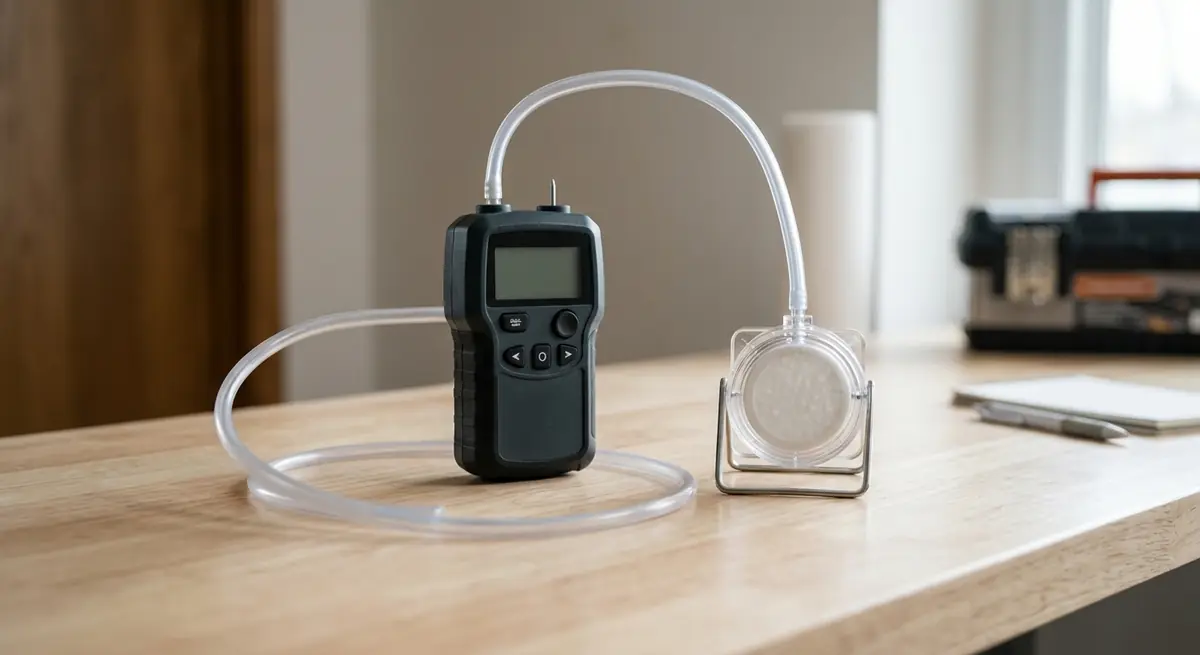
A mold test pays off in Dallas in 2 cases: a persistent musty smell with no visible growth, where samples confirm hidden mold, and the end of a job, where samples support clearance. Visible growth on a vent goes straight to removal.
What a lab result cannot tell you
- Whether visible mold comes out: it does regardless, and EPA calls sampling unnecessary in most such cases.
- Which species is safer: CDC sees no need to identify the type of mold.
- Whether a count is too high: EPA has set no federal limits for airborne mold or spores.
- Who will get sick: CDC states that sampling and culturing cannot show whether someone might become sick.
Reading a Dallas air sample
An air sample means something only beside an outdoor sample taken the same day, because EPA's benchmark after cleanup is indoor mold types and levels similar to the outdoors. A sample collected at a supply register with the system running shows what the ducts deliver; one collected with the system off shows the room. Swab and tape-lift samples show what grows on one spot, such as a duct liner or ceiling stain, and EPA names surface sampling as a way to judge whether an area was adequately cleaned. Home kits and sampling methods are compared in national terms in our guide to mold inspection or mold testing.
Who can inspect for mold in Texas?
In Texas, mold assessors and remediators are licensed by the Texas Department of Licensing and Regulation (TDLR) under Occupations Code chapter 1958, and the same company generally cannot do both the assessment and the remediation on one project.
TDLR's FAQ extends the license to anyone who inspects and tests buildings for mold. Real estate inspectors who collect air or spore samples must hold a TDLR mold assessment technician or consultant license. The only exception TDLR names to the separation rule is a school district employee working on a district project.
For a Dallas owner the separation rule has a practical effect: the assessor who writes the protocol earns nothing from the removal. Senate Bill 1255 amended chapter 1958 effective 09/01/2025, and TDLR states that its mold rules stay in effect while new rules are written. Ask 4 questions before the visit:
- License: the TDLR mold assessment license number, and whether it is a consultant or technician license.
- Independence: written confirmation that the firm will not bid on the removal.
- Laboratory: which lab reads the samples, and whether an outdoor control sample is included.
- Paperwork: the Consumer Mold Information Sheet, which TDLR-licensed assessors hand each client before work starts.
How is a Dallas mold job cleared under Texas rules?
A Dallas mold job clears through a post-remediation assessment by the TDLR-licensed consultant who wrote the protocol. The visit confirms the moisture source is fixed and no visible mold remains; the remediator then issues the Certificate of Mold Damage Remediation (CMDR).
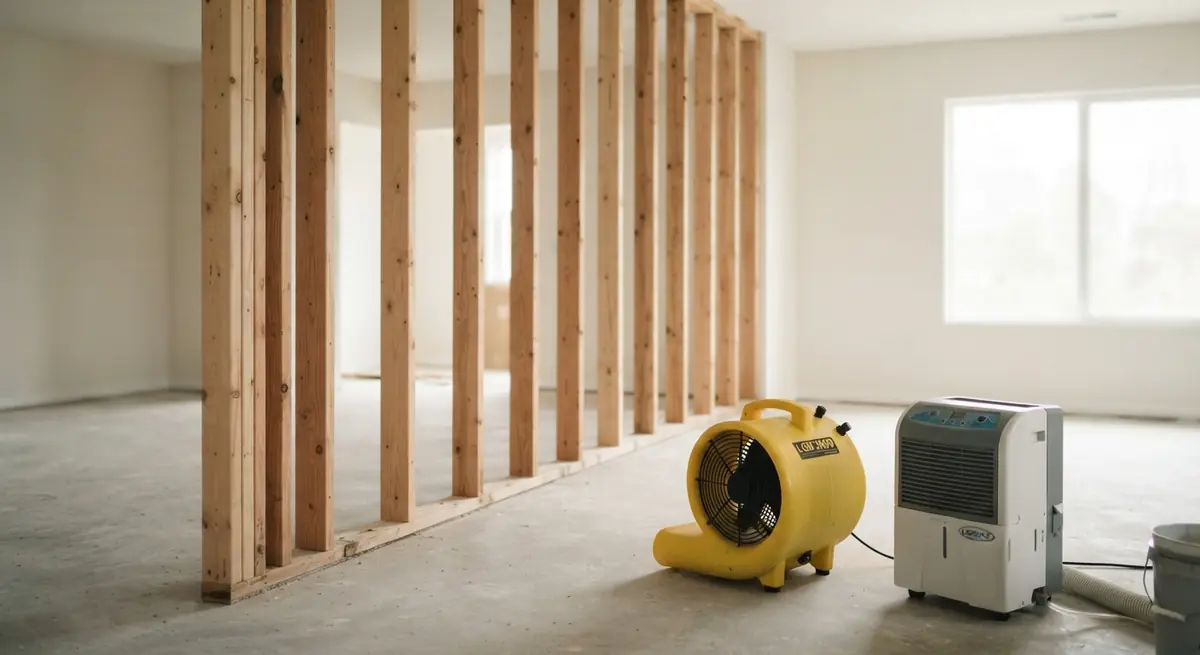
TDLR's FAQ states that a consultant who did not prepare a protocol in advance cannot declare that a project achieved clearance. EPA's criteria for a finished cleanup describe what the visit looks for: the water problem corrected, no mold, mold-damaged material or moldy odor left, and, where samples are taken, indoor mold types and levels that resemble the outdoors. On an air conditioning job, that covers the coil, the pan and any replaced duct sections, not only the room.
Keep the CMDR
The CMDR is a Texas Department of Insurance form. TDLR's FAQ states that an insurer may not base an adverse underwriting decision on earlier mold damage when the statute and rules were met, so the certificate belongs with your home and insurance records.
When the assessment fails
A failed assessment names the area that still shows growth, a wet reading or a high sample. The remediation contractor cleans that area again inside the same containment, and the consultant repeats the assessment there before the job closes.
How much does a mold inspection cost in Dallas?
HomeAdvisor (Angi) lists an average of $505 for mold testing in Dallas, TX, with a typical range of $356 to $697 (checked 11/12/2026). The specialist's estimate on the call sets your price, based on house size, areas checked and samples taken.
| Figure | Value | Publisher and date | Status |
|---|---|---|---|
| Average total | $505 | HomeAdvisor (Angi), checked 11/12/2026 | Dallas listing, read in search results, not independently verified |
| Typical range | $356 to $697 | HomeAdvisor (Angi), checked 11/12/2026 | Dallas listing, read in search results, not independently verified |
| Lowest to highest | $216 to $1,100 | HomeAdvisor (Angi), checked 11/12/2026 | Dallas listing, read in search results, not independently verified |
Fee drivers
- House size: a single bathroom takes less time than a survey from the air handler to the attic.
- System access: opening the air handler and following attic duct runs adds time on site.
- Samples: each air or surface sample carries its own lab charge, plus an outdoor control for air tests.
- Protocol: ask whether the written remediation protocol is part of the inspection price or a separate line.
- Clearance: the post-remediation assessment is a second visit with its own fee.
The inspection fee and the removal price are separate numbers. Published Dallas removal averages, price drivers and a quote checklist are on our page about mold remediation prices in Dallas.
What happens after a Dallas inspection finds mold?
The inspection report becomes the remediation scope. Under 25 contiguous square feet, TDLR rules let an unlicensed person clean the area; larger hired jobs go to a licensed remediation contractor, a different firm from the assessor, working to the consultant's protocol.
EPA sizes containment the same way the inspector measures: limited containment for 10 to 100 square feet, full containment above that. The steps, the Dallas mold drivers and the full list of covered ZIP codes sit on our page about mold remediation in Dallas. One call to (856) 595-8837 books either visit.
Dallas mold inspection FAQ
Can a home inspector test for mold during a Dallas home purchase?
Only with a mold license. TDLR's FAQ states that a real estate inspector who collects air or spore samples must hold a mold assessment technician or consultant license. A standard home inspection reports visible stains and leaks without sampling.
Why can't the inspector also remove the mold in Texas?
Texas rules bar one company from performing both the assessment and the remediation on the same project, with a narrow exception for school district employees. The split keeps the firm that judges the work from grading its own removal.
Do I need an inspection for a small patch of mold?
Not for a visible patch under about 10 square feet. EPA places that size within homeowner cleanup, and TDLR lets unlicensed people clean less than 25 contiguous square feet. Book an inspection when the smell outlasts the cleanup.
Should air ducts be tested before they are cleaned?
Rarely. Visible growth on a register, coil or duct liner already justifies cleaning or replacement, and EPA supports replacing wet or moldy fiberglass duct material. A sample helps when the vents smell musty and nothing shows.
Does a Dallas mold inspection include a written report?
Ask for one when booking. A useful report lists each affected area with square footage, moisture and humidity readings, the water source and any lab results. Under Texas rules the assessment consultant's protocol builds on that report.
Musty vents or a stain you want checked in Dallas? Call (856) 595-8837. A support manager books your time, and a local specialist states the inspection estimate on the call.
Call (856) 595-8837